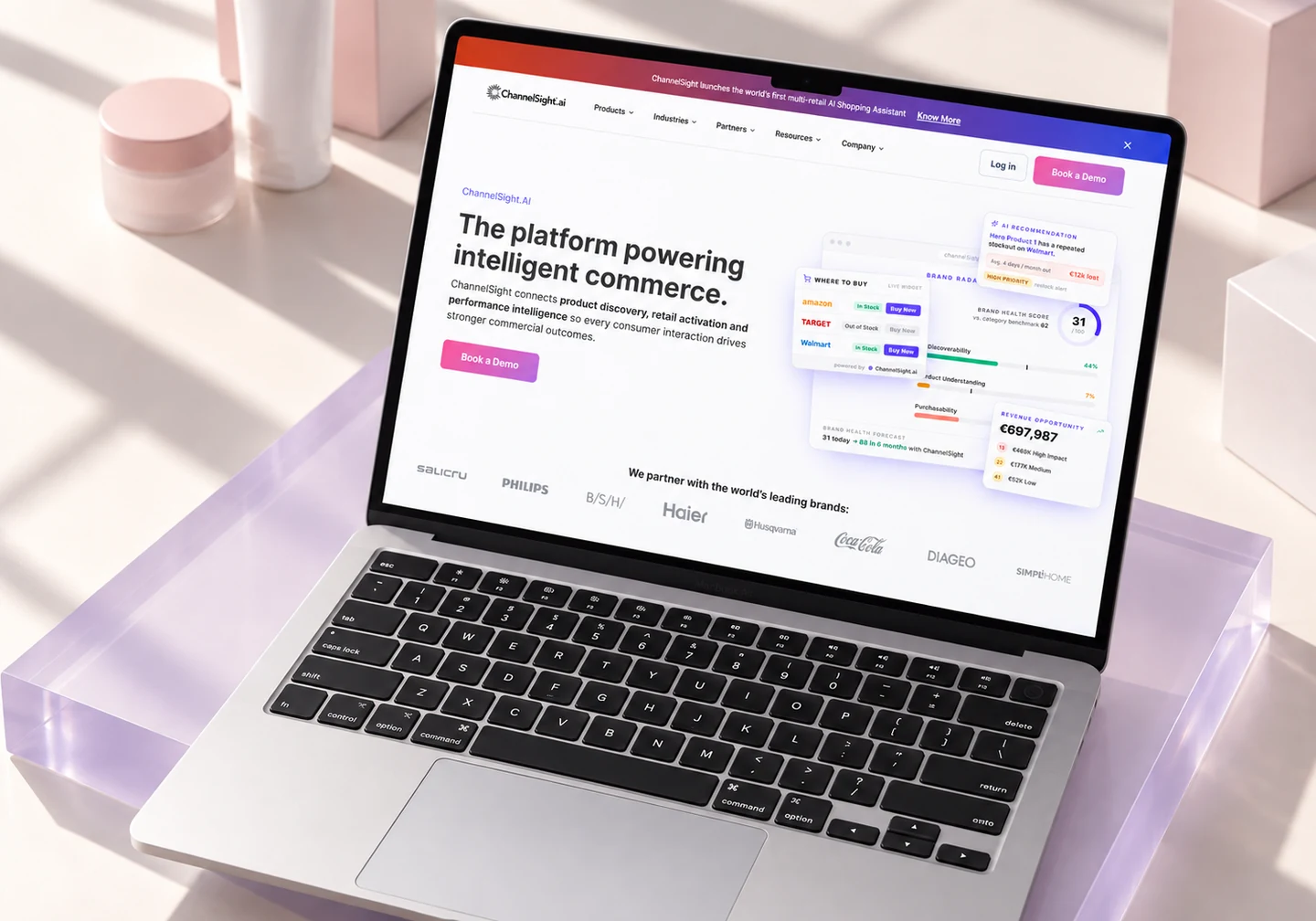
ChannelSight: Making a commerce platform readable to AI engines
ChatGPT, Gemini, Claude, Perplexity and Google’s AI answers cite ChannelSight ahead of every competitor. Case studies and industry pages now run on reusable sections the marketing team edits itself.
- Sector
- Commerce technology
- Services
- Technical SEO, AI visibility
- Platform
- Webflow
- Timeframe
- Mid-June to 12 October 2026
The record· Every figure with its source
- Most-cited source across six AI assistants
- No. 1
- SourceWeekly checks, still first on 12 October 2026
- Pages carrying structured data, of 586 crawled
- 0 → 475
- SourceFull crawl, 15 July 2026. Zero in mid-June.
- Low-value URLs, a drop of 83%
- 2,349 → 410
- SourceFull crawl, 15 July 2026
- Pages given a search title and description
- 385
- Source371 blog posts and 14 case studies
- Readability score on our 100-point audit
- 30 → 59
- SourceThe same audit, re-run two months later
§ 01Context
The brief.
ChannelSight is a where-to-buy and digital shelf platform for consumer brands. It connects buying intent on brand sites, media and campaigns to live retailer product pages, and tracks the journey from content to purchase. As it repositioned toward AI and agentic commerce, its own site carried no structured data anywhere, while every direct competitor did.
§ 02The challenge
The only company in its category that AI engines could not read.
In mid-June, zero pages on ChannelSight’s site carried structured data, not even the FAQ page that already had written answers. Every direct competitor had it. 371 blog posts and all 14 case studies had no search titles or descriptions, crawlers wasted effort on 2,349 junk URLs, and our 100-point readability audit scored the site 30.
§ 03The solution
Making every page legible to machines.
Structured data, site-wide
Organization markup across the site, Article markup on every blog post, plus FAQ and Breadcrumb markup. Hand-written JSON-LD on the 33 pages that do the selling: five product pages marked up as software, the how-it-works pages and 19 topic cluster pages.
The snippets and titles the site never had
Search titles and descriptions written for 371 blog posts and 14 case studies, 385 pages in total, each drawn from the page’s own summary or opening. The homepage title, previously just “ChannelSight.ai”, now says what the company does.
Crawl budget pointed at real pages
Pagination blocked in robots.txt, self-referencing canonicals on every page, and a 714-line generated file whose homepage entry was blank replaced with a hand-written llms.txt.
Sections the marketing team edits
Case studies and industry pages rebuilt on reusable sections the marketing team edits itself, with eight new industry pages live.
§ 04The outcome
The most-cited domain in the sample.
475 pages machine-readable, from zero
On 15 July, 475 of 586 crawled pages carried structured data, and low-value URLs fell from 2,349 to 410, a drop of 83%.
Readability score, 30 to 59
The same audit, re-run two months later. Structured data went from 0 to 18 of 30, and technical foundations from 1 to 12 of 25.
Most-cited domain in the panel
Fourteen buyer questions went to ChatGPT, Claude, Perplexity and Gemini on 15 July 2026. channelsight.com was cited ahead of MikMak, Pear and Wayvia combined, and weekly checks across six assistants still ranked it first on 12 October 2026.
Built to be re-measured
The June baseline is repeatable, so every figure is a like-for-like before and after, and the next round is measured rather than asserted.
K2 Group
Search impressions up 42% across K2’s websites.